Skip to content
Cognitive function capsule · Reviewed August 2026

Three official websites. Three different products.

Cognifort is sold as an “Memory & Mind Support”. Before you compare prices, it is worth knowing that the sites selling it disagree about whether it is a capsule or a powder, what is in it, and whether your money-back window is 60 days or 180. This is the independent Cognifort reference, and the most useful thing on it is a table you can check in two minutes.

Daily serving
2 capsules
Per bottle
30 caps
Doses published
None
Sale from
$39/btl
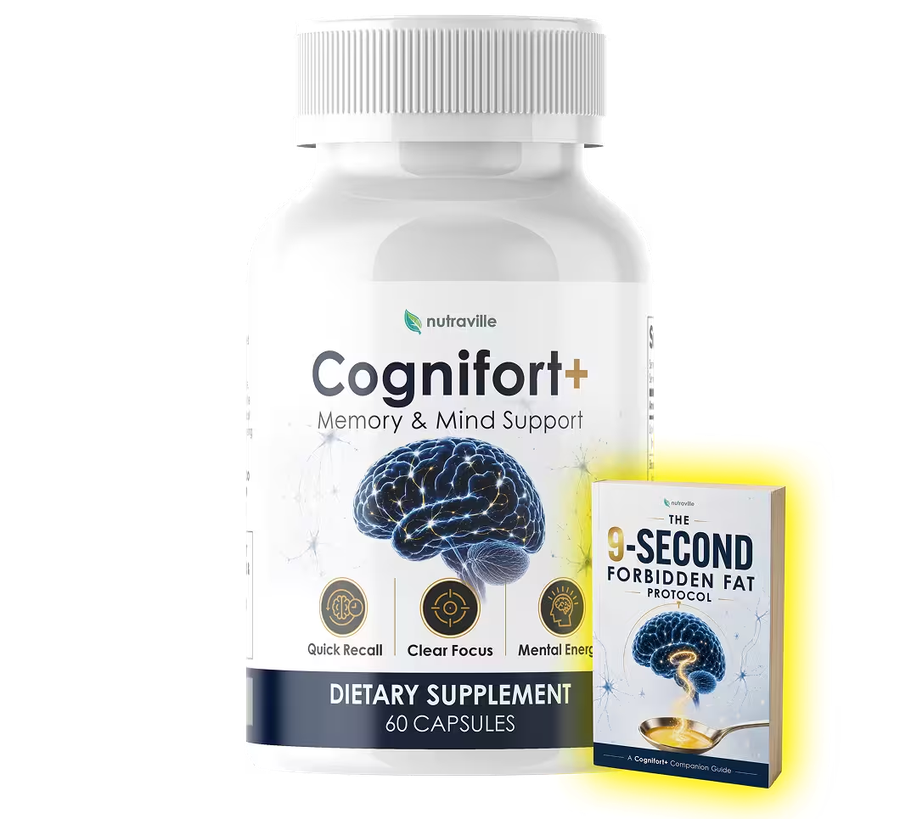
Cognifort official website — three bottles of Cognifort Memory & Mind Support, 30 capsules each
  • Guarantee: 60 or 180 days?
  • Capsule or powder?
  • Zero doses published
  • Prices differ by page
  • Every claim checked
The short answer

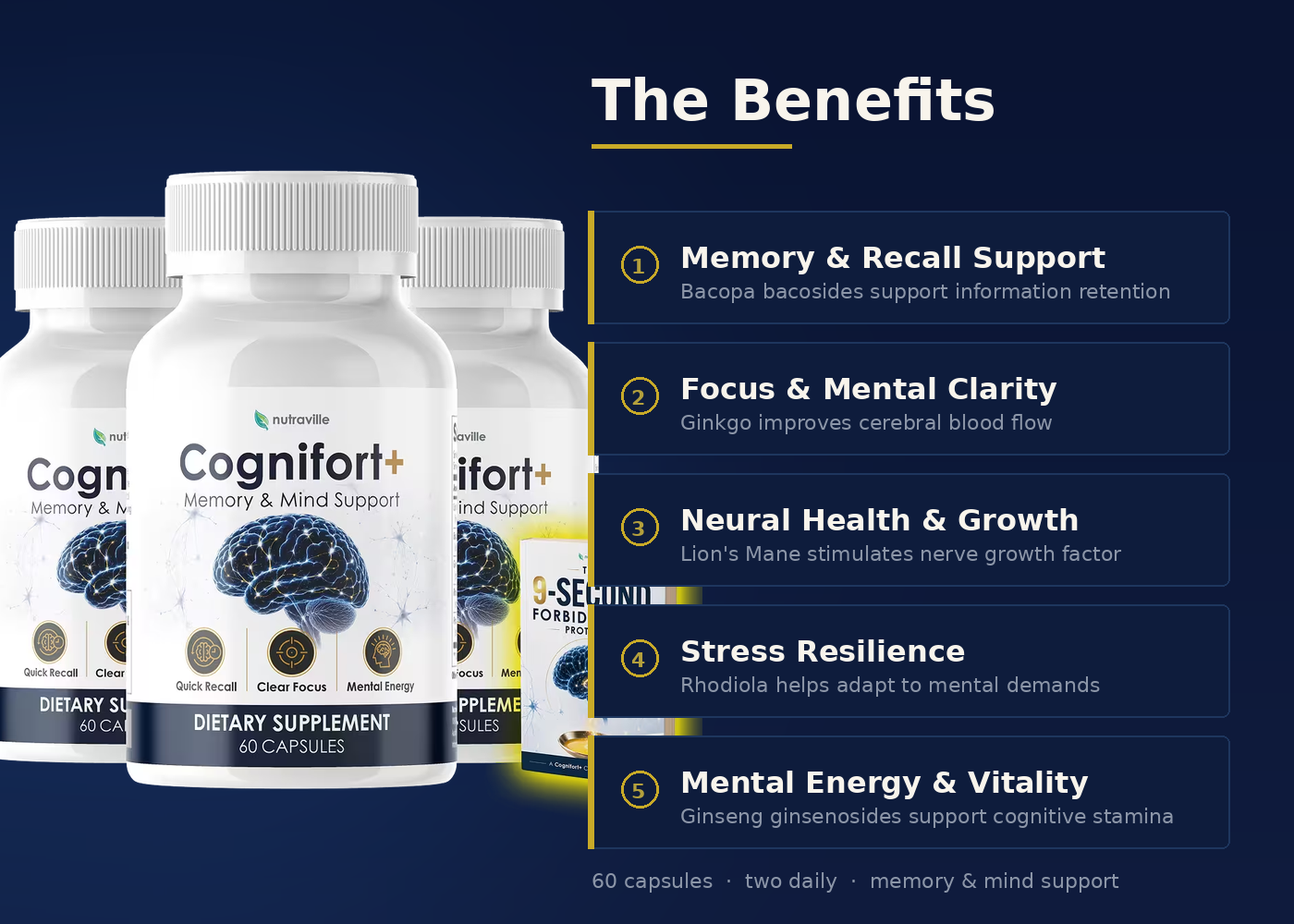
Cognifort is a cognitive-support supplement sold under the tagline “Memory & Mind Support” — and which product you actually receive depends on which website you order from. The bottle artwork shows capsules, 60 per bottle, taken once daily, with icons claiming memory support, cognitive focus and daily energy.

It is a dietary supplement rather than a medicine, and it is not FDA-approved. Packages run roughly $39 to $69 a bottle depending on the page and quantity. No page publishes a single milligram figure for any ingredient, and the money-back period is stated as 180 days in one place and 60 days in another.

Before anything else: check your medication list. Cognifort contains Ginkgo Biloba, which affects blood clotting and interacts with anticoagulants, antiplatelet drugs and several medications metabolised by the liver. It also contains Rhodiola Rosea, which may interact with antidepressants, blood pressure medication and immunosuppressants. Panax Ginseng can affect blood sugar and blood pressure. Take the ingredient list to a pharmacist before ordering, especially if you take prescription medication of any kind. No doses are published for any ingredient, so a pharmacist cannot assess the magnitude of any interaction — which is itself the concern.

What Cognifort actually is

Strip away the branding and you have a cognitive-support supplement built from ingredients that are, individually, entirely legitimate. Green tea extract has real thermogenic research behind it. Chicory inulin is a genuine, well-studied prebiotic fibre. Apple cider vinegar has a plausible mechanism and a few small trials. Nobody invented these compounds.

Two problems sit on top of that. The first is that no amount is published for any of them, anywhere — and for the fibre ingredients in particular, the researched amounts are measured in grams, which is not something a single capsule can contain. Our page on what Cognifort is works through the product and who it genuinely suits.

The second is stranger, and it is the reason this site leads with a comparison table instead of an ingredient list. The websites selling Cognifort do not agree on what Cognifort is. One describes a powder you stir into cold water and says plainly “no pills, no fuss.” Another describes capsules you refrigerate after opening, built around a prebiotic and probiotic blend. Those are not variations on a theme; they are different products in different categories.

You do not have to take our word for any of it. Open the two pages side by side and read the ingredient lists.

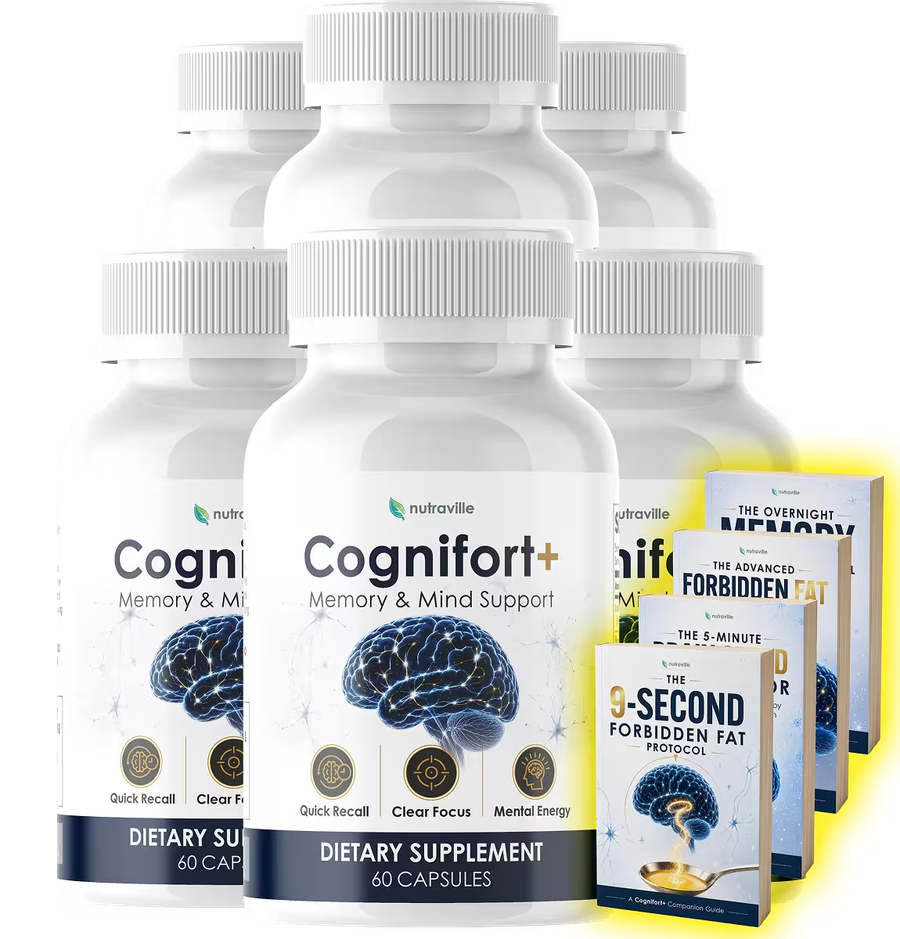
Cognifort 6 bottle package — what is Cognifort, 180 day supply of cognitive support capsules
The six-bottle package, the lowest per-bottle price on either page — and, on the 60-day terms, the one whose supply outlasts its own guarantee by four months.
The check nobody else publishes

Which Cognifort are you buying?

Three sources, all presenting themselves as authoritative on this product. Read the three columns together and the question answers itself.

Site A

Powder — one scoop in water

“One scoop a day — no pills, no fuss”

Ingredients
Green Tea Extract, Apple Cider Vinegar, “Fiber Blend”, “Vitamin B Complex”
Doses published
None — four groupings, no amounts
Money-back window
180 days
Pricing
2 btl $158 · 3 btl $207 · 6 btl $294

Order page resolves to a different store domain entirely. Page theme colour is green; the bottle is pink.
Site B

Capsules — two daily, refrigerate after opening

“A prebiotic and probiotic combination that works directly in your gut”

Ingredients
Chicory Root Inulin, Potato Resistant Starch, 3-strain Probiotic Blend
Doses published
None — three ingredients, no amounts
Money-back window
60 days, plus a 30-day minimum-use condition
Pricing
2 btl $158 · 3 btl $207 · 6 btl $294

Countdown timer, “96% of customers order 6 bottles”, savings anchored on $179 a bottle, and Portuguese-language image filenames.

The bottle

Capsules — 60 per bottle

“Memory & Mind Support · Cognitive Function”

Ingredients
Not printed on the artwork. Icons claim memory support, cognitive focus and cognitive support.
Doses published
No Supplement Facts panel visible
Money-back window
Not stated on the packaging
Pricing

A metabolic formula is not the same category as a gut prebiotic, and neither is a drink powder.

How to read this. None of these ingredients is disreputable, and we grade them fairly further down this page. The finding is about identity: a buyer who reads one page and orders from another has no reliable idea what will arrive, what is in it, or how long they have to send it back. That is not a subtlety — it is the single most important practical fact about this purchase.

What to do about it. Read the ingredient list on the exact page you are ordering from. Screenshot it, and the guarantee text, with the date visible. Photograph the Supplement Facts panel when the bottle arrives and compare the two. If they differ, you have a documented basis for a refund request. See the full ingredient breakdown.

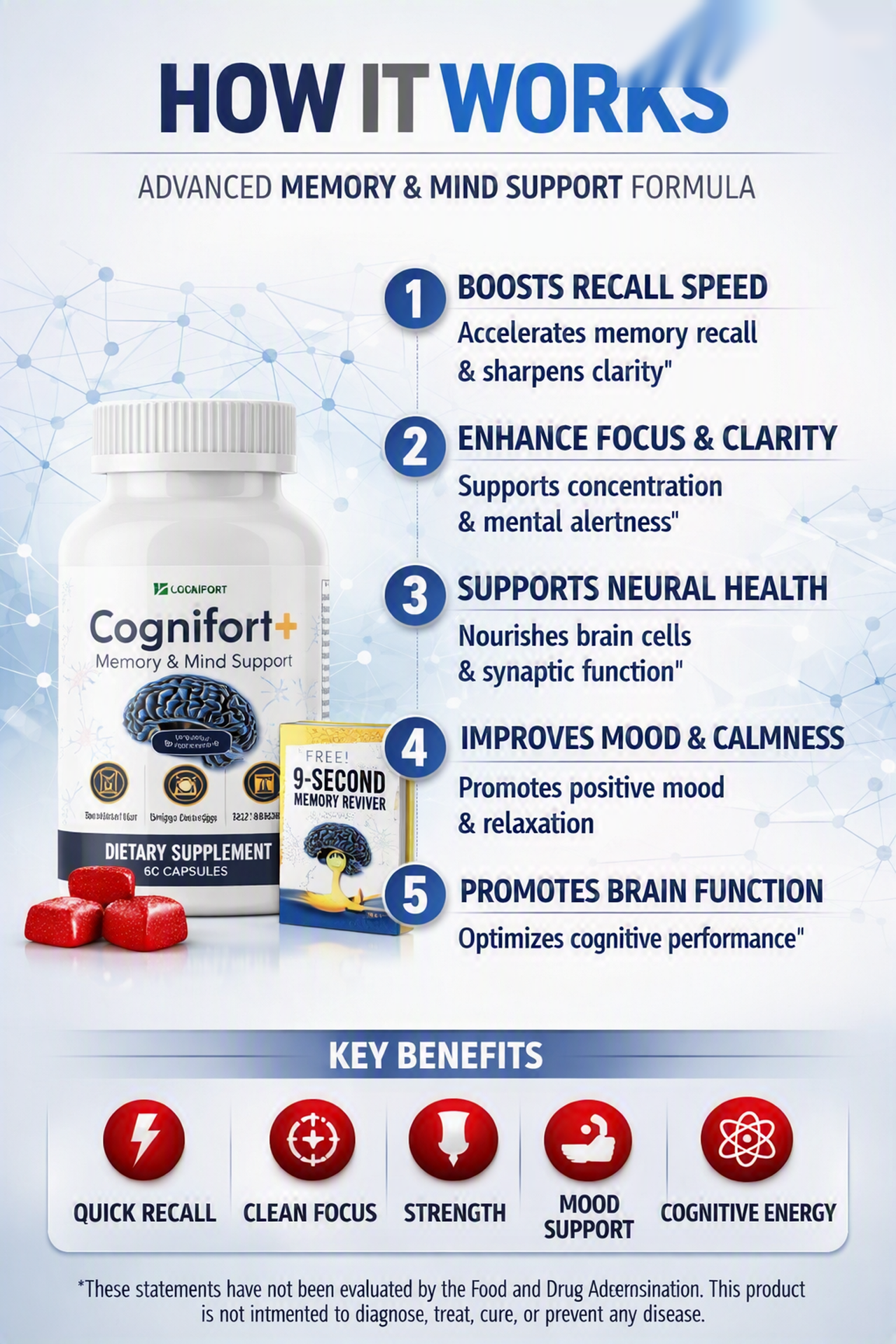
How Cognifort works — restores memory function, boosts cognitive focus, supports brain health, enhances mental vitality
Manufacturer-supplied graphic. The claims shown in brand artwork are the manufacturer’s; the assessment on this page is ours.
Mechanism

How the formula is meant to work

The artwork above promises four things: reduced memory and recall, boosted fat metabolism, cognitive support support and enhanced daily vitality. Two of those have real mechanisms behind them. Two are marketing.

Memory and recall — a real mechanism. Fermentable fibre works here, genuinely. Inulin and resistant starch increase stool bulk, slow gastric emptying and ferment into short-chain fatty acids that influence satiety signalling. Acetic acid from vinegar slows gastric emptying too. The catch is entirely one of amount: those effects are demonstrated at 5 to 30 grams of fibre daily.

Cognitive focus — real but small. Green tea catechins modestly raise energy expenditure and fat oxidation, more so alongside caffeine. Meta-analyses report average weight differences of a kilogram or two over months. Real, measurable in aggregate, and considerably less than the phrase “boosts cognitive focus” implies.

“Enhances daily vitality” — not a mechanism. Nothing on any of these ingredient lists is an energy compound in a direct sense. If B vitamins are present at meaningful amounts they correct a deficiency you probably do not have.

And the claim that undoes itself. One page attributes the whole effect to rebalancing your gut microbiome; another attributes it to thermogenesis and fibre. Both cannot describe the same capsule.

Read the full mechanism breakdown →

Their numbers, not ours

The refund clock

The check the review titles keep asking for

The refund clock

One product name, one purchase decision, and four different answers to “how long do I have to change my mind?” Every bar below is drawn on the same 180-day scale, using the numbers each page publishes about itself.

  • Site A — the powder page“Try it for a full 180 days — if you’re not completely satisfied, contact us for a hassle-free, full refund.” Stated four separate times on that page.180 days
  • Site B — the capsule page“An unconditional 60-day guarantee from the date of purchase” — then, in the same paragraph, “if, after at least 30 days of use, you are not completely satisfied…” A minimum-use requirement is a condition.60 days
  • Site B — your effective windowIf you must use it for 30 days before claiming and the window closes at day 60, the period in which you can actually act is roughly days 30 to 60. Half of what the headline number implies.30 days
  • A paid advertorial for the brandA sponsored newswire article about this product refers to 30-day return requirements and to subscription details — while Site B answers “is there any hidden subscription?” with “Not at all!”30 days

Why this matters more than the price. A refund window is the only real protection a buyer has in this category, because nobody can verify the formula in advance. If you believe you have 180 days and you actually have days 30 to 60, you will discover the difference at exactly the moment it cannot be fixed. Screenshot the guarantee text on the page you order from, with the date visible, and diarise day 50 regardless of what it says.

The evidence dossier

Every named ingredient, graded fairly

This covers every ingredient named across all the Cognifort pages, because a buyer might receive any of them. The bar measures how much published human research supports that ingredient for weight or appetite specifically, before the dose question is applied.

  • Green Tea Extract (EGCG)Real, modest, dose-dependent
    54/100

    The most studied ingredient that appears on any Cognifort page. Catechins, principally EGCG, raise energy expenditure slightly and meta-analyses report small average weight differences — typically a kilogram or two over months, often not sustained. Trials generally used 250–500 mg of catechins daily, frequently alongside caffeine, which is where much of the thermogenic effect comes from. Worth knowing that high-dose concentrated green tea extract carries a documented, rare liver-injury signal — EFSA has reviewed it and several national regulators have issued cautions.

  • Chicory Root InulinGenuine prebiotic fibre
    50/100

    A real, well-characterised prebiotic that ferments in the colon and feeds Bifidobacteria. Evidence for satiety and for modest metabolic markers exists, and European authorities have accepted a bowel-function claim for it. But the studied amounts are 5–15 grams daily — that is grams, in a sachet or a tablespoon, not something a single capsule can hold. Expect gas and bloating in the first fortnight; that is the fibre working, and it is dose-related.

  • Apple Cider VinegarSmall trials, large marketing
    34/100

    Acetic acid has a plausible mechanism — it slows gastric emptying and blunts the post-meal glucose rise — and a handful of small trials report modest weight differences. The studies used roughly 15–30 ml of liquid vinegar daily, equivalent to well over a gram of acetic acid. Dried ACV powder in a capsule delivers a fraction of that, and the acetic acid content of a powder is rarely stated at all.

  • Potato Resistant StarchReal fibre, gram-scale
    42/100

    Resistant starch reaches the colon undigested and ferments into short-chain fatty acids, with reasonable evidence for insulin sensitivity and satiety. Same problem as inulin: the trials use 15–30 grams daily. There is no capsule format in which this ingredient can be delivered at a researched amount, and any product listing it in a capsule is listing it for the label rather than the effect.

  • “Probiotic Blend” (3 strains, unnamed)Strain-specific or nothing
    22/100

    Probiotic evidence is strain-specific, not species-specific and certainly not category-specific — a finding for one documented strain says nothing about another. A blend described only as “three strains” with no strain designations and no CFU count cannot be evaluated at all. Akkermansia muciniphila is named in passing on one page; it is a genuinely interesting organism in metabolic research, and it is also difficult to keep viable, which is presumably why that page tells you to refrigerate the bottle.

  • “Fiber Blend” / “Vitamin B Complex”Not ingredients, categories
    10/100

    These are the two entries on the powder page that are not ingredients at all. A “fiber blend” could be inulin, psyllium, acacia, cellulose or maltodextrin — compounds with entirely different effects. A “vitamin B complex” could be any subset of eight vitamins at any amount. Naming a category instead of a compound is the least informative thing a label can do while still appearing to disclose something.

The arithmetic underneath all of this. Two of these ingredients are dosed in grams in the research: chicory inulin at 5–15 g daily and resistant starch at 15–30 g. A large capsule holds roughly 800 mg of powder in total. Delivering even the low end of the inulin range would require about six capsules of nothing but inulin, and the label says two capsules containing several ingredients. Fibre at a researched dose comes in a sachet or a scoop, which is presumably why one of these pages sells a powder — and that page is the one that does not mention fibre by name.

Ask for the panel in writing before ordering. One email with four questions — the milligram amount of each active, the catechin standardisation, the probiotic strain designations and CFU count, and the acetic acid content of the ACV powder — would settle most of what this page has to reason around.

Cognifort benefits — appetite and portion support, steady daily energy, a routine you can keep
Benefits composition built from the product artwork, with each claim stated at the level the ingredient research supports.
Benefits

What to expect, sized to the evidence

The marketing promises memory support and accelerated cognitive focus. The ingredient research supports something real but considerably smaller, and the missing doses shrink it further.

  • Appetite and portion support. The best-founded claim here — if the fibre is present at a meaningful amount, which in a capsule it cannot be.
  • A modest metabolic nudge. Green tea catechins, genuinely, at 250–500 mg. Amount here unknown.
  • Post-meal glucose smoothing. Plausible from acetic acid and fibre, demonstrated at 15–30 ml of vinegar.
  • “Boosts cognitive focus.” Overstated. A kilogram or two over months in trials, not a transformation.
  • “Enhances daily vitality.” Not supported by anything on any of these lists.

Benefits & realistic expectations →

Read this before you buy

The interaction board

Find your situation below. This covers the documented interaction categories for every ingredient named across the Cognifort pages, since you may receive any of them. It is not a complete list and not medical advice.

  • See a doctor
    Unexplained weight change, thirst, or persistent fatigue

    Weight that moves without a change in habits is a symptom, not a supplement gap. Thyroid disease, type 2 diabetes, depression and several common medications all present this way, and all are diagnosable with tests a capsule cannot replace. Months spent on a supplement while one of them goes unexamined is the most expensive purchase in this category.

  • Prescriber first
    Diabetes medication — metformin, a sulfonylurea, insulin

    Green tea catechins, acetic acid and fermentable fibre can each nudge glucose downward. Stacked onto medication that already lowers it, the risk is hypoglycaemia. If you use a glucose monitor, test more often for the first few weeks and tell your prescriber what you started.

  • Ask first
    Liver disease, or any history of raised liver enzymes

    Concentrated green tea extract carries a rare but documented liver-injury signal, reviewed by EFSA and flagged by several regulators. The risk appears related to high-dose extracts taken on an empty stomach rather than to drinking tea. With no milligram figure published, you cannot know where a given product sits.

  • Ask first
    Warfarin or another anticoagulant

    Green tea contains vitamin K and can reduce warfarin’s effect. The amount in an extract varies with processing and is not disclosed here, which makes it unpredictable rather than necessarily large.

  • Caution
    Immune suppression, central line, or serious illness

    Live probiotics are generally very safe in healthy adults, but bacteraemia and fungaemia have been reported in severely immunocompromised patients and in people with central venous access. This is a specialist conversation, not a label to guess at.

  • Caution
    IBS, or a sensitive gut

    Inulin and resistant starch are fermentable fibres — inulin is high in FODMAPs. If you manage IBS with a low-FODMAP approach, this is exactly the ingredient class that triggers symptoms. Start low and expect a fortnight of adjustment at minimum.

  • Separate doses
    Levothyroxine, iron, or any medicine with an absorption window

    Fibre binds medicines in the gut and slows or reduces absorption. Separate any fibre-containing supplement from thyroid medication and iron by at least four hours.

  • Expect this
    Gas and bloating in the first two weeks

    The predictable effect of fermentable fibre, and dose-related. It usually settles. If it does not settle within a fortnight, stop — there is no benefit worth ongoing discomfort.

  • No
    Pregnancy, nursing, or under 18

    Not formulated or studied for these groups, and cognitive-support supplements are specifically inappropriate during pregnancy. The seller states this too.

  • Lower concern
    Healthy adult, no medication, no gut sensitivity

    Interaction risk drops considerably. The honest question then becomes whether an undisclosed amount of green tea extract and fibre is worth $49–$79 a bottle — and whether you know which of the three products you are receiving.

01

Reasonable fit

Healthy adult, no regular medication, no gut sensitivity, wanting mild appetite support alongside diet and activity changes you are already making.

02

Ask a pharmacist

Diabetes medication, warfarin, levothyroxine, or a history of raised liver enzymes. All four intersect with something on these lists.

03

See a doctor first

Unexplained weight change, thirst, or persistent fatigue. Those are symptoms with treatable causes and tests that take minutes.

Transparency scorecard

What a careful buyer can actually verify

Buyer checkPublished hereOfficial Cognifort pages
Which product shipsThree versions comparedPages contradict each other
Capsule or powderBoth documentedOne says each
Individual dosesFlagged undisclosedNone published anywhere
Supplement Facts panelStated as not shownNot displayed
Fibre dose vs capsule capacityChartedNever compared
Probiotic strains & CFUNamed as missing“Three strains”, no detail
Guarantee lengthBoth versions shown180 on one page, 60 on another
Minimum-use conditionExplainedCalled “unconditional” anyway
SubscriptionContradiction documented“Not at all” vs advertorial
Green tea liver cautionStated plainlyNot mentioned
Pricing arithmeticVerified — consistent on one pageTotals multiply correctly
Reference price basisIdentified as fictional$179 and $99 anchors
Manufacturer identityStated as unnamedNo brand named

Reflects the Cognifort pages as reviewed in August 2026. Pages change — verify current claims yourself.

Customer experiences

What buyers tell us, mixed reports included

★★☆☆☆

“Two stars, and it’s about the ordering rather than the product. I read one site, ordered from another, and got capsules when I’d expected a drink powder. The ingredient list on the bottle wasn’t what I’d read either. It went back, but only because I’d screenshotted the page.”

Illustrative portrait accompanying a customer testimonial
Carla D.Returned · wrong format
★★★★☆

“Four stars for honesty. I take metformin and had no idea green tea extract and fibre could both nudge my glucose down. My pharmacist looked at it for two minutes and said to test more often for a fortnight. Nobody selling it mentioned that.”

Illustrative portrait accompanying a customer testimonial
Nadine K.Verified purchase · 3-bottle
★★★☆☆

“Three stars. I lost about four pounds over three months, but I also started walking after dinner and cut out my afternoon soda because the bonus guide told me to. I genuinely can’t say it was the capsules, and I suspect it wasn’t.”

Illustrative portrait accompanying a customer testimonial
Bernard O.Verified purchase · 6-bottle

Testimonials are individual experiences and are not a guarantee of results. Portraits are illustrative stock images, not photographs of the reviewers. One Cognifort page claims 4.9 out of 5 from 2,734 customers with no link to any third-party platform, and we found no independent review record on the BBB, Trustpilot or comparable sites in either direction — we would rather tell you that than imply a track record that does not yet exist. Read the full independent review.

Cognifort discount & pricing

Three packages, priced differently on different pages

Both pages sell one, three and six bottles. Neither agrees with the other on what a bottle costs. Here is what each quotes, and which option the arithmetic supports.

Starter

1–2 Bottles

30–60 day supply

Cognifort 2 bottle starter package — 60 day supply of cognitive support capsules
$79per bottle

2 btl $158 ($79 each) + shipping

  • Highest per-bottle price on either page
  • Shipping charged separately on both
  • Smallest amount at risk
  • The package we would take, if any
Check Starter Price
Most promoted

3 Bottles

90-day supply

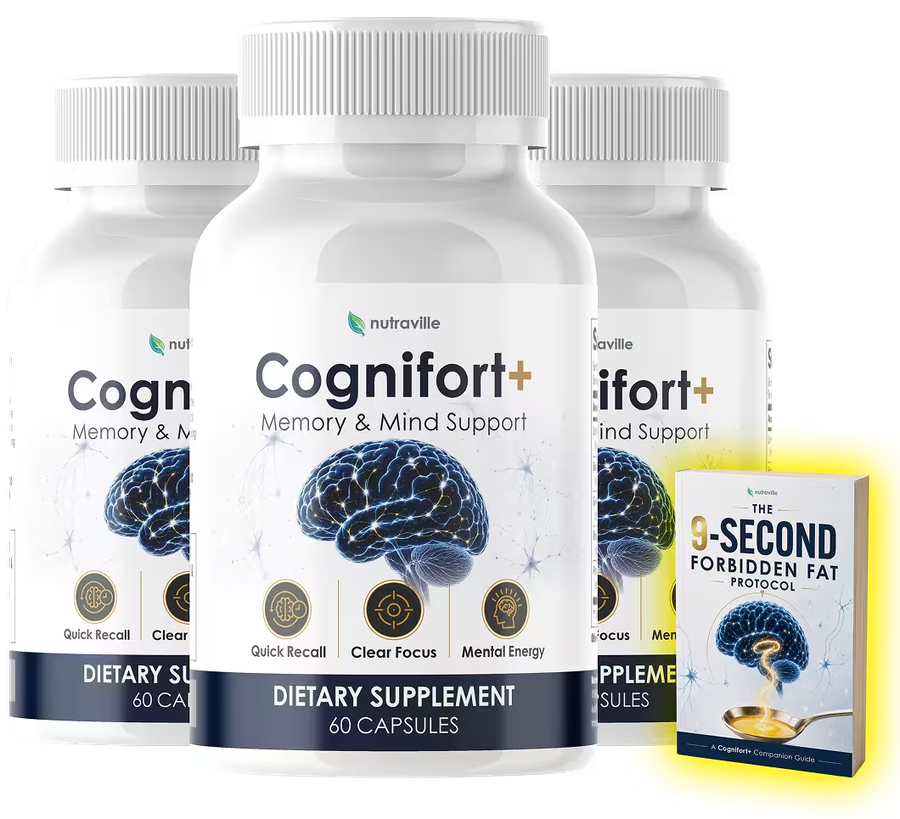
Cognifort 3 bottle package — 90 day supply with free US shipping
$69per bottle

3 btl $207 ($69 each) · free US shipping

  • Free US shipping on both pages
  • Site B adds six digital bonus guides
  • A $20 per-bottle gap between the two pages
  • 90 days outlasts Site B’s guarantee by 30
Check 3-Bottle Discount
Lowest per bottle

6 Bottles

180-day supply

Cognifort 6 bottle package — 180 day supply at the lowest per bottle sale price
$49per bottle

6 btl $294 ($49 each) · free US shipping

  • Free US shipping on both pages
  • Lowest cost per day — and the largest commitment
  • Site B anchors savings on a $179 reference price
  • 180 days of product against a 60-day window
Check 6-Bottle Sale

The prices do not agree either. This is the part that catches people out. The two pages selling “Cognifort” quote different money for the same bottle count: Both pages list the same three-tier pricing: 2 bottles at $79 each, 3 at $69 each, 6 at $49 each. Six bottles is $49 a bottle on both pages, and $49 on the other. That is a $60 difference on a six-bottle order, for a product with the same name.

Site B’s arithmetic is at least internally consistent — $79×2 = $158, $69×3 = $207, $49×6 = $294 all multiply correctly, which is worth crediting. What is not real is the reference price those savings are measured from: every anchor resolves to $179 per bottle, a figure that appears nowhere except crossed out. Site A does the same thing with a $99 anchor.

What we would do. Take the smallest package on whichever page you trust, screenshot the ingredient list and the guarantee text with the date visible, and diarise day 50. The largest package is the lowest cost per day and the worst first purchase, because on Site B’s terms two thirds of it falls outside the refund window before you have opened bottle three.

Good Manufacturing Practice certified facility
Produced in a GMP-certified facility
Made in the USA
Manufactured in the United States
Natural ingredients badge supplied by the manufacturer
Plant-derived actives — see every one graded
Money-back guarantee seal supplied by the manufacturer
Guarantee length differs by page — read why
Visa, Mastercard, American Express and Discover accepted
Checkout handled by the seller’s processor

Pricing on both pages verified 2026-08-28. These pages change; confirm your final total, the ingredient list and the refund terms before submitting your order.

The guarantee, decoded

How to protect yourself when the terms disagree

You cannot control which version of the policy applies to your order. You can control the evidence you hold about what you were promised, and in practice that is what decides a disputed refund.

01

Screenshot before you pay

Capture the guarantee text, the ingredient list and the price, with the date visible. This is the single most useful thing you can do, and it takes ten seconds.

02

Diarise day 50

Assume the shorter window until proven otherwise. If the terms turn out to be 180 days you have lost nothing by deciding early.

03

Ask the three unasked questions

Does product have to be returned? Are opened bottles accepted? Who pays return postage? None of these is published on either page.

04

Check your statement

The descriptor may not match the brand. Note it at checkout, and check the following month for a second charge despite the no-subscription claim.

Photograph the panel on arrival. If the Supplement Facts panel on the bottle does not match the ingredient list on the page you bought from, you have a documented, concrete basis for a refund request that does not depend on whether the product worked — and given that these pages describe different formulas, that is a real possibility rather than a theoretical one. Full detail on the refund policy page.

Answers, directly

Cognifort FAQ

Cognifort is a cognitive-support supplement sold under the tagline “Memory & Mind Support”, and the honest answer is that which product you receive depends on which website you order from. The bottle artwork shows a capsule product, 30 capsules per bottle, two daily. One official-looking site sells a powder you stir into water. Another sells a prebiotic and probiotic capsule with an entirely different ingredient list. It is a dietary supplement, not a medicine, and it is not FDA-approved. See the three-site comparison.

That depends on the page. One site lists Green Tea Extract, Apple Cider Vinegar, a “Fiber Blend” and a “Vitamin B Complex”. Another lists Chicory Root Inulin, Potato Resistant Starch and a three-strain probiotic blend. Those are different products — a thermogenic-and-fibre formula versus a gut-microbiome formula. Neither publishes a single milligram figure, and two of the four entries on the first list are ingredient categories rather than ingredients. Full detail on the ingredients page.

No. Not on any page we could find. No Supplement Facts panel is displayed, no blend total is given, and no individual amounts appear. That matters because the fibre ingredients on one of the lists — inulin and resistant starch — are studied at 5–30 grams daily, amounts no capsule can hold, and green tea catechin trials used 250–500 mg. Without numbers, none of that can be checked.

Either 180 days or 60 days, depending which page you read. One site states 180 days, four times over. Another states an “unconditional 60-day guarantee” and then, in the same paragraph, requires “at least 30 days of use” before a claim — which makes the practical window roughly days 30 to 60. A paid advertorial about the product refers to 30-day return requirements. Screenshot the terms on your page. See the refund clock.

The pages disagree here too. Both pages list 2 bottles at $79 each, 3 at $69 each and 6 at $49 each. The other lists two bottles at $158 ($79 each), three at $207 ($69 each) and six at $294 ($49 each) — a $10 to $20 per-bottle difference for the same quantity. Savings on both are measured against reference prices ($179 and $99 a bottle) that appear only as crossed-out numbers. Current pricing is on the Cognifort official website.

No, and no dietary supplement is. The FDA does not approve supplements the way it approves prescription drugs — there is no pre-market approval and no requirement to demonstrate efficacy before sale. Facilities are registered and subject to inspection, which is a different thing. One of these pages displays an “FDA” badge, which is misleading on any supplement.

Both, according to its own marketing, which is the clearest illustration of the problem. The bottle artwork and one site describe capsules, 60 per bottle, two daily. Another site says explicitly “one scoop a day — no pills, no fuss” and instructs you to stir it into cold water. A product cannot be both, so at least one of those pages is describing something other than what it ships.

No trial has been published on any of these finished products, so the only honest assessment is ingredient by ingredient — and without doses even that is limited. Green tea extract has real but modest evidence at 250–500 mg of catechins. Inulin and resistant starch have real satiety evidence at gram-scale amounts a capsule cannot deliver. Expect little, and treat any improvement as most likely coming from the diet and activity changes that accompany starting something new.

One page suggests several weeks, another gives no timeline. Judged by the ingredients, green tea and fibre trials ran 8–12 weeks, so 90 days would be a fair assessment window — which on the 60-day guarantee sits a month past your refund deadline. If you try it, weigh weekly at the same time and compare fortnightly averages, and decide by day 50.

No manufacturer is named on either page. Checkout routes to third-party order platforms and, in one case, the page’s own canonical URL points to a completely different store domain. One page carries Portuguese-language image filenames and an expert endorsement from a person whose credentials are not verifiable. There is no company standing behind the formula in the way there would be behind an established brand.

Through the Cognifort official website — but note that several sites claim that status and they sell different products. No authorised retail listing has been identified. Whichever page you use, buying elsewhere puts your purchase outside that seller’s order records, which is what any guarantee is administered against.

There is no evidence that orders go unfulfilled, and the ingredients named are real compounds with genuine research behind some of them. Our criticism is narrower and more specific: three sites claim to be official and describe three different products; no page publishes a single dose; the guarantee is 180 days in one place and 60 with a 30-day condition in another; the prices differ by up to $20 a bottle; savings are anchored on prices nobody has paid; one page runs a countdown timer that resets on reload; and no manufacturer is named anywhere. Our full review weighs whether that adds up to a purchase worth making.

Reviewed & edited

Who checks this page

Dr. Maren Solberg, PharmD, BCGP

Clinical reviewer

Board-certified ambulatory care pharmacist with thirteen years in metabolic and cognitive-support clinics. Signs off every safety claim on this site, including the green tea liver caution and the glucose-lowering interactions on the board above.

Julian Voss

Editor

Consumer health editor. Verifies ingredient data, pricing and refund terms against the seller’s own pages before anything goes live, and re-checks when those pages change. Read our editorial policy.

Check the Cognifort sale price Read the full review

Cognifort from $39/bottleGuarantee: check your page
See Discount